




Arduino Starter Kit, Learning Kits, Robot Car Kits, Robotics, Show All Learning Kits, Show All Robotics
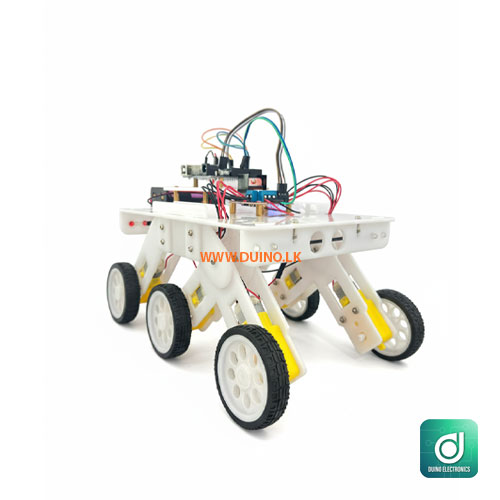
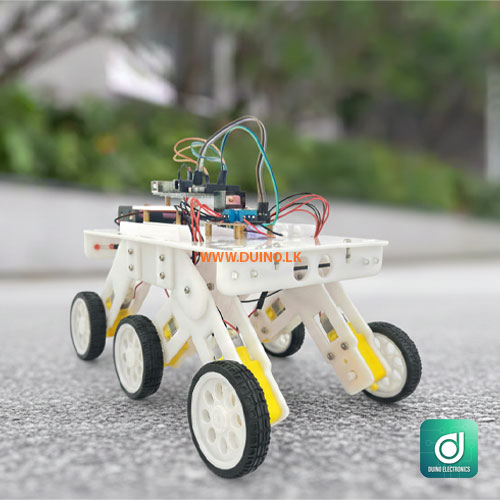
6 Wheel Drive Curious Chassis *Bluetooth Control Full Kit for DIY Robotics 3mm Acrylic 28x18x14.5cm
SKU: RB5065
Availability:
In stock
Acrylic 6 Wheel Drive Curious Chassis Kit for DIY Robotics
Price range: රු12,430.00 through රු12,950.00
6 Wheel Drive Curious Chassis Kit for DIY Robotics
The Arduino Bluetooth 6-Wheel Rover is a beginner-friendly DIY robotics project designed for students, hobbyists, and electronics enthusiasts. Built using an Arduino Uno, motor driver, and Bluetooth module, this rover can be wirelessly controlled using a smartphone, making it an exciting and hands-on way to learn robotics.
The 6-wheel drive design provides extra strength, balance, and stability compared to standard rover kits, allowing smoother movement and better traction. This project helps users understand the fundamentals of Arduino programming, motor control, electronics, and wireless communication.
The rover can also be further enhanced and upgraded as your skills grow. Advanced users can experiment with additional technologies such as NRF wireless modules, Wi-Fi, GPS, sensors, and automation, making this kit a strong foundation for future robotics projects.
Key Features
Beginner-friendly Arduino robotics kit
Bluetooth-controlled via smartphone
Strong and stable 6-wheel drive system
Ideal for learning Arduino, electronics, and wireless control
Expandable for advanced control using NRF, Wi-Fi, GPS, and more
Package Includes
1 × 6-Wheel Car Chassis Kit (3mm pre-cut acrylic sheet)
6 × DC Gear TT Motors
6 × Yellow Wheels
3mm Nuts & Bolts, Spacers (as required)
1 × Arduino Uno Board
1 × USB Cable for Uno Board
1 × L298N Motor Driver Module
1 × HC-06 Bluetooth Module
2 × 18650 Rechargeable Batteries
1 × Dual 18650 Battery Charger
1 × Dual 18650 Battery Holder
10 × Male-to-Male Jumper Wires
10 × Male-to-Male Jumper Wires
10 × 220 ohm Resistors
10 × 5mm Leds
1 × On-Off Switch
4M × Circuit Wires
Mobile App Required
A Bluetooth control mobile app is required to operate the rover.
App Link: (Add your mobile app link here)
Other Required Tools & Accessories (Not Included)
To assemble and complete this DIY kit, the following basic tools and accessories are required. These items are not included with the product and should be arranged separately:
Soldering iron – for soldering electronic components
Soldering lead (solder wire) – required for making electrical connections
Screwdriver – for assembling the chassis and mounting components
Small plier – useful for holding components, bending wires, and tightening parts
These commonly available tools ensure proper assembly and safe handling during the build process. This kit is recommended for users with basic electronics and DIY experience.
**************************
Technical Specifications
Size : 28cm x 18cm x14.5cm
Chassis Type: 6-Wheel Drive Rover Chassis
Material: 3mm Acrylic (Laser-cut)
Drive System: 6 × DC Gear TT Motors
Wheel Type: Yellow Plastic Wheels
Controller Board: Arduino Uno (ATmega328P)
Motor Driver: L298N Dual H-Bridge Motor Driver
Wireless Communication: HC-06 Bluetooth Module
Control Method: Smartphone via Bluetooth Mobile App
Power Supply:
2 × 18650 Rechargeable Li-ion Batteries
Dual 18650 Battery Holder
Dual 18650 Battery Charger
Operating Voltage:
Arduino Uno: 5V
Motors: 6V–12V (via motor driver)
Expandability: Supports additional modules such as NRF24L01, Wi-Fi, GPS, sensors, cameras, etc.
Skill Level: Beginner to Intermediate
Learning Objectives
By assembling and programming this rover, users will learn:
Basics of Arduino programming and IDE usage
Understanding DC motor control using an H-bridge motor driver
Bluetooth communication between Arduino and a smartphone
Power management using Li-ion batteries
Basic robot chassis assembly and wiring
Introduction to wireless robotics control
How to upgrade and expand a project using technologies like NRF, Wi-Fi, GPS, and sensors
This kit is ideal for students, hobbyists, STEM education, school projects, and DIY robotics learning.
***************************
Curriculum-Style Learning Path (School / STEM Use)
Level 1: Introduction to Robotics & Safety
Objectives:
Understand what a robot is and how mobile robots work
Learn basic electronics safety and battery handling
Identify components in the kit
Topics Covered:
What is Arduino and where it is used
Overview of DC motors, wheels, and chassis
Safe use of 18650 batteries
Outcome:
Students can identify all components and understand basic robotics concepts.
Level 2: Mechanical Assembly
Objectives:
Build the physical rover correctly
Learn basic mechanical skills
Activities:
Assemble the 6-wheel acrylic chassis
Mount motors and wheels
Properly fix nuts and bolts
Outcome:
Students complete a stable 6-wheel rover chassis.
Level 3: Basic Electronics & Wiring
Objectives:
Understand power flow and connections
Learn correct wiring practices
Topics Covered:
Arduino Uno pin functions
L298N motor driver connections
Battery holder and power wiring
Outcome:
Students can wire the rover correctly and safely.
Level 4: Arduino Programming Fundamentals
Objectives:
Learn basic coding concepts
Upload programs to Arduino
Topics Covered:
Arduino IDE setup
Digital pins, PWM, and delays
Controlling motors using code
Activities:
Write code to move forward, backward, left, and right
Outcome:
Students can program basic rover movements.
Level 5: Bluetooth Control with Smartphone
Objectives:
Understand wireless communication
Control the rover using a mobile app
Topics Covered:
HC-06 Bluetooth module basics
Serial communication
Mapping mobile app buttons to rover movements
Activities:
Drive the rover using a smartphone
Outcome:
Students achieve real-time wireless control.
Level 6: Debugging & Testing
Objectives:
Improve problem-solving skills
Learn troubleshooting techniques
Topics Covered:
Common wiring and code errors
Motor direction issues
Bluetooth pairing problems
Outcome:
Students can independently debug and fix common issues.
Level 7: Project Customization & Creativity
Objectives:
Encourage creativity and innovation
Activities:
Change speed using PWM
Modify code for smoother control
Design obstacle navigation logic
Outcome:
Students personalize their rover behavior.
Level 8: Advanced Expansion (Optional)
Objectives:
Introduce advanced robotics concepts
Possible Upgrades:
NRF24L01 for long-range control
Wi-Fi modules for IoT control
GPS for location tracking
Sensors (ultrasonic, IR, line follower)
Outcome:
Students understand how simple robots evolve into advanced systems.
Level 9: Final Project & Assessment
Objectives:
Apply all learned skills in one project
Activities:
Design a custom rover application
Demonstrate a working robot
Present project concept and improvements
Outcome:
Students complete a full STEM robotics project with real-world relevance.
Recommended Age Group
Upper Primary (with guidance)
Secondary School Students
STEM Clubs & Technical Colleges
| Choose Color | Transparent, White |
|---|---|
| Choose Package | With 65mm x 15mm White color Wheels, With 65mm x 28mm Yellow color Wheels |
Based on 0 reviews
Only logged in customers who have purchased this product may leave a review.
Related products
-
Arduino Compatible, Arduino Compatible, Arduino Compatible Kits, Arduino Starter Kit, Learning Kits, Mother Boards, Sensors, Show All Learning Kits, Special Learning Kit
37 IN 1 Sensor Kit For Arduino *Without Plastic Container
 Arduino Compatible, Arduino Compatible, Arduino Compatible Kits, Arduino Starter Kit, Learning Kits, Mother Boards, Sensors, Show All Learning Kits, Special Learning Kit
37 IN 1 Sensor Kit For Arduino *Without Plastic Container
37 IN 1 Sensor Kit For Arduino Without Plastic Container in sri lanka
SKU: Duino-Kit-10-1 -
Arduino Compatible, Arduino Compatible, Arduino Compatible Kits, Arduino Starter Kit, Learning Kits, Mother Boards, Show All Learning Kits, Special Learning Kit
Starter Kit Pro 01 For Arduino & Robotics Program





There are no reviews yet.