




Distance Measuring Sensors, Sensors, Show All Sensors
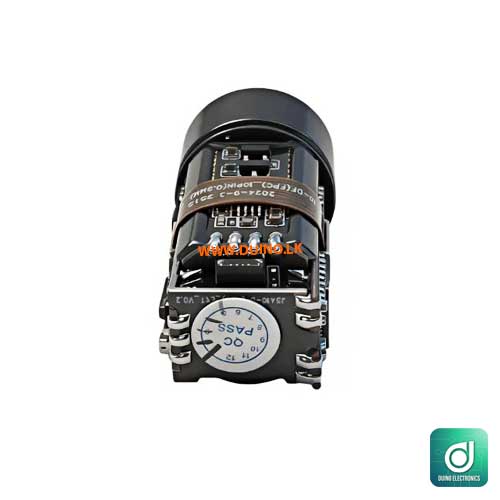
LRF1000A 1000m 905nm ToF Laser Rangefinder Module
SKU: SEN1678
Availability:
In stock
LRF1000A 1000m 905nm ToF Laser Rangefinder Module
Price range: රු35,900.00 through රු38,790.00
LRF1000A 1000m 905nm ToF Laser Rangefinder Module
LRF1000A 1000 m 905 nm ToF Laser Rangefinder Module for Handheld Devices, Surveying Instruments and UAV Platforms
The LRF1000A is a 905 nm ToF laser rangefinder module that measures 5–1000 m on building-type targets with ±0.7 m up to 200 m and ±(0.7 + 0.0004·d) m beyond, 0.1 m resolution and ≥98% accuracy rate. It runs from 3.3–5 V DC with ≤0.85 W power, weighs 10 g in a Φ17 × 37.2 mm housing and outputs data over a UART (TTL_3.3 V) interface using ERDI’s standard command protocol, making it ideal for handheld rangefinders, surveying instruments, UAV distance sensing and compact automation devices.
The LRF1000A is a compact 905 nm Time-of-Flight (ToF) laser rangefinder module designed as an OEM distance core for handheld laser rangefinders, surveying instruments, UAV / UGV platforms and compact industrial devices. By measuring the round-trip time of a pulsed 905 nm laser beam, it delivers stable distance data from 5 m to 1000 m on building-type targets under visibility ≥ 6 km.
The sensor is classified as Class 1 eye-safe (IEC 60825-1) and operates at 905 ±10 nm with a typical laser divergence of 4 × 6 mrad and a receiver field of view around 8 mrad, giving a practical spot size for targets such as walls, sign boards, trees or vehicles. Distance accuracy on construction-type targets is specified as ±0.7 m within 200 m, and ±(0.7 + 0.0004·d) m beyond 200 m, where d is distance in meters. Measurement resolution is 0.1 m, with an accuracy rate of ≥98% and a measurement frequency of 1–3 Hz, suitable for handheld reading, surveying workflows and slow to medium speed platform motion.
Electrically, the module is powered from DC 3.3–5 V, with ≤0.5 W standby power and ≤0.85 W operating power at 3.3 V, which makes it easy to integrate into battery-powered devices. The default UART baud rate is 15200 bps, and the module also supports 9600, 38400 and 57600 bps for different host requirements. The interface is UART (TTL_3.3 V), and ERDI provides PC configuration software plus a standardised command set that supports single-shot and continuous measurement, baud rate configuration, external circuit enable/disable and low-power modes.
Mechanically, the LRF1000C keeps a very small footprint with a weight of 10 ±0.5 g and dimensions of Φ17 × 37.2 mm, making it well-suited for compact handheld housings, optical tubes, UAV pods and small robotic heads. The mechanical drawing on page 4 of the datasheet shows the front optics and recommended external window layout, including suggestions for H-K9L optical glass, wedge angle tolerance ≤3′, surface roughness around Ra 0.012, and anti-reflection coatings optimised for 855–955 nm with ≥99.5% transmittance and ≥98% overall transmittance after protective films.
The UART protocol uses 8-byte frames with a 0x55 0xAA header. Function words control single measurements, continuous measurements, stop commands, angular output (for configurations with an angle sensor) and system settings. Replies include a status byte STA (0 = failure, 1 = success), high and low bytes of distance or angle and a checksum based on the low eight bits of the sum of the verified bytes. Distance data are transmitted in hexadecimal, with all measurement values scaled by 10, so the host simply divides by 10 to obtain metres. The module also supports a secondary low-power mode: when the external circuit is disabled via command, the MCU remains in standby but can respond to subsequent measurement commands without a full power cycle.
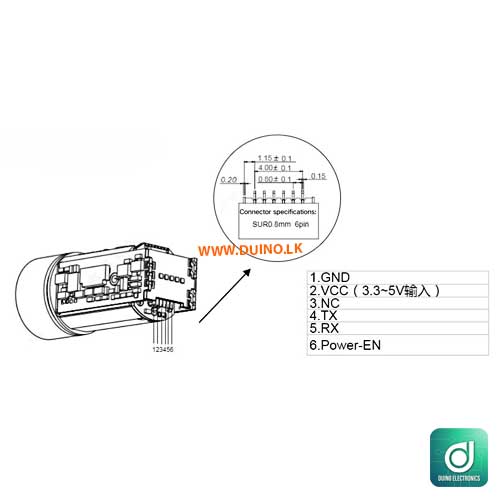
The hardware interface uses connector model HC-0.8-6PWT, with pins for GND, VCC (3.3–5 V input), TX, RX and Power-EN. The enable pin is pulled low (<0.3 V) to power the module off and pulled high (>3 V) to power on; when enabling during operation, the host should wait about 300 ms before reading data to allow proper startup. Shock resistance is specified as 1200 g, 1 ms, and vibration as 5–50–5 Hz, 1 octave/min, 2.5 g. The operating temperature range is −20 °C to +70 °C, with storage from −25 °C to +75 °C, and MTBF ≥1500 h, covering typical handheld, field-survey and embedded use-cases.
The datasheet also lists practical guidance on factors affecting performance, including target reflectivity, target shape, incidence angle and atmospheric conditions. Under typical conditions—medium-reflectivity building walls, perpendicular incidence and clear weather without direct sunlight—the module achieves its specified 5–1000 m range. For long-distance measurement, ERDI recommends fixing the module to a tripod or stable platform to minimize vibration and improve repeatability.
With its 5–1000 m range, 0.1 m resolution, Class 1 eye safety, 3.3–5 V supply, low mass of about 10 g and open UART protocol, the LRF1000C is a strong candidate for OEM handheld rangefinders, compact surveying equipment, golf or outdoor rangefinders, UAV/UGV distance sensing and small industrial automation systems that require accurate, low-power 905 nm distance measurement.
Performance Indicators
Eye safety class – Class 1(IEC 60825-1)
Laser wavelength – 905±10nm
Laser divergence angle (typical) – 4×6mrad
Receiver field of view – ~8mrad
Maximum range (Visibility ≥ 6Km) – ≥1000m @70% reflectivity, building targets
Minimum range – 5m
Ranging accuracy – (Construction target) – d≤200m:±0.7m d>200m:±(0.7+0.0004*d)m (d represents distance, in meters)
Measurement frequency – 1~3Hz
Accuracy rate – ≥98%
Measurement resolution – 0.1m
Electrical Specifications
Baud rate – 15200bps (factory setting)/57600bps/38400bps/9600bps
Interface type – UART(TTL_3.3V)
Supply voltage – DC 3.3V~5V
Standby power consumption – ≤0.5W
Operating power consumption (+3.3Vin) – ≤0.85W
Startup time – ≤550ms
Physical characteristics
Weight – 10±0.5g
Dimensions – Φ17×37.2 mm
Shock – 1200g,1ms
Vibration – 5~50~5 Hz, 1 octave/min, 2.5g
Environmental adaptability
Operating temperature – -20~+70℃
Storage temperature – -25~+75℃
Reliability – MTBF≥1500h
Interface Type: UART (TTL_3.3V)
Connector Model: HC-0.8-6PWT
Pin Definition Description
1 GND Ground wire
2 VCC 3.3V DC power supply
3 NC Empty pin
4 TX Serial port transmitting end, TTL_3.3V level
5 RX Serial port receiving end, TTL_3.3V level
6 Power – EN Low level to power on
POWER – EN Control Instructions:
Pull down <0.3V to disable the module; pull up >3V to enable the module.
Pull from low to high during operation, with a 300mS delay to read data.
The 905nm Laser Rangefinder Module 1000m delivers precise distance measurements from 5 to 1000 meters using advanced TOF technology. Featuring a UART (TTL_3.3V) interface, it supports both single-shot and continuous modes, plus PC software for easy, standardized configuration.
| Payment Option | pay in 3 installments, pay with online transfer / card payment or bank deposit |
|---|
Based on 0 reviews
Only logged in customers who have purchased this product may leave a review.
Related products
-
Modules, Sensors, Show All Modules, Show All Sensors, Sound Detection Sensors
Sensitivity Control Sound Detection Sensor Module
 Modules, Sensors, Show All Modules, Show All Sensors, Sound Detection Sensors
Sensitivity Control Sound Detection Sensor Module
Features:
Main chip: LM393, Electret condenser microphone
Great for Acoustic control light , give sound and light alarm working with Photosensitive sensor ,and sound control,sound detect
Signal output indication
Single channel signal output
Effective output signal is low level
Working voltage: DC 4V-6V
Note:The Maximum induction distance is 0.5M
Specification:
Weight: 4g
Size: 3.1×1.6×0.8cm
Package Included:
1 xSound Sensor Detection Module
SKU: SEN1522




There are no reviews yet.